If you’ve ever looked at a polished granite countertop, a honed slate floor, or a smooth marble sink, you’ve probably thought, “How does that get so flawless?” Most people blame the stone itself, the grit of the polishing compound, or even the skill of the person doing the work. But here’s the thing: the unsung hero behind that finish, the part most guys in the stone industry don’t geek out over enough, is the flexible polishing pad. As a flexible polishing pad supplier, I get asked this question all the time—like, “How does a squishy, bendy pad even grind and polish stone, instead of just smushing it?” Let’s break this down, no boring engineering jargon, just the real way these things work. Flexible Polishing Pad

First, let’s set the scene. Stone is not some hard, uniform block of rock. It’s porous, has tiny cracks, uneven mineral grains, and different areas that are way harder than others. If you grab a rigid polishing pad—like a hard fiber disc or a stiff pad made for metal—and run it over granite, what happens? It digs too deep into the soft parts, skips over the hard bits, and leaves you with scratches that are impossible to buff out. Think of it like sanding a wall with a brick: it’ll scrape the high spots, but it’ll leave deep, uneven gouges you can’t fix easily. That’s where flexibility comes in, and it’s not just for comfort (though yeah, flexible pads are way easier on your wrists when you’re polishing 50 square feet of kitchen countertops).
A flexible polishing pad’s main trick is something called “conformability,” and that’s the science part that makes magic happen. Let’s get super basic here: the pad itself isn’t just a thin piece of rubber. It’s made from a mix of foam, urethane, and sometimes tiny micro-resin beads that give it that squishy, springy texture. The thing is, it doesn’t press flat like a rigid pad. When you run it over stone, it conforms to every tiny bump and grain on the stone’s surface. So instead of the pad only touching the high points (like a rigid pad would), it’s making contact with the entire surface—even those tiny, recessed spots between mineral grains. That means the polishing compound (the gritty stuff we mix with water, usually) is applied evenly, not just in the places where the rigid pad was digging in. No more deep scratches from over-grinding the soft parts, and no more missed spots on the hard granite quartz grains.
Wait, but flexibility isn’t just about shape—it’s about give under pressure. That’s the next big piece. When you’re polishing stone, you’re not just rubbing it back and forth; you’re applying consistent, light pressure. A rigid pad will dig in harder if you press down more, leading to uneven results. A flexible pad? It “gives” when you apply extra pressure. If you accidentally press a little too hard into a small crack, the pad squishes instead of grinding that crack deeper. If a mineral grain is extra hard, the pad stays just firm enough to grind it down, but doesn’t push so hard that it leaves a scar. Think of it like using a soft eraser vs. a hard pencil eraser: the soft one gets into the nooks and crannies without tearing the paper (or the stone). That’s exactly what flexible polishing pads do for stone.
Now, let’s talk about the grit progression, because that’s where the flexibility really shines. Stone polishing isn’t a one-step thing. You start with rough grit pads (like 50-grit) to grind down deep scratches and unevenness, then move to 150, 300, 800, 1500, 3000, and finally 8000-grit to get that glossy, wet-look finish. Every grit step needs a different level of flexibility, and that’s not an accident. The rough 50-grit pads need a little stiffness to do the heavy grinding—enough bite to take off big chunks of stone, but still flexible enough to not leave deep gouges. The 8000-grit finishing pads? They need to be super soft, almost like a thick sponge, to catch the tiny 8,000-grit abrasive particles and buff out the micro-scratches that the previous grit left. A rigid pad at the finishing stage would never get that super-smooth, glass-like finish because it can’t conform to the tiny, almost invisible scratches you need to buff out.
Here’s something most people don’t know about flexible polishing pads: they also help with heat control. When you grind or polish stone, friction creates heat. Too much heat can crack the stone, especially delicate marble or limestone, and even ruin the abrasive grit on the pad. A rigid pad doesn’t absorb heat—it transfers it straight to the stone, which is bad news. A flexible pad, with all that foam and air pockets inside, acts like a tiny heat sink. It absorbs the heat from friction, keeps it from hitting the stone, and even lets water (we usually use a water mist when polishing) flow through those air pockets to carry heat away. That’s why you can polish a 10-foot slab of marble in one go without worrying about it cracking, something you can’t do with a rigid pad.
Wait, let’s bust a myth real quick. Some guys in the stone industry think flexible pads are only for hand polishing, but no—they work great with large floor polishers, too. When you mount a flexible pad to a machine, the pad’s flexibility makes up for any tiny wobble in the polisher. If your machine is slightly off-center, a rigid pad would grind a dip in the stone, but a flexible pad flexes with the wobble, so the surface stays smooth. That’s why big commercial stone jobs (like hotel lobbies or airport floors) use flexible pads exclusively now—they’re way faster, more consistent, and less likely to ruin a $1000 slab of granite than old rigid fiber discs.
Now, as someone who’s been supplying flexible polishing pads to stone fabricators and masons for years, I’ve seen firsthand how this works in real life. I had a customer a few months back who was struggling with granite countertops that kept getting swirl marks after polishing. He’d been using rigid pads for years, and no matter how much he adjusted his polisher, he couldn’t get rid of them. We suggested switching to our medium-flex polishing pads for the finishing stages, and he called me a week later saying he cut his polishing time in half and the countertops looked like they had a clear coat on them—no swirls, no unevenness. That’s the power of a well-designed flexible polishing pad.
Let’s make this concrete (pun intended) with a quick example. Imagine a rough piece of granite: it’s got high quartz ridges, soft feldspar valleys, and tiny hairline cracks. A rigid pad would grind the high quartz ridges super hard (leaving deep scratches) and barely touch the soft feldspar valleys (so they’re still rough). A flexible pad conforms to every ridge and valley, so it grinds the quartz just enough to level it with the feldspar, and doesn’t dig into the cracks at all. Then, when you move to finer grits, that same flexibility lets the pad reach all the tiny spots left by the previous grit, so you don’t have to spend extra hours hand-buffing the edges.
Another thing: flexible pads last longer than rigid ones, too. Because they don’t dig into the stone or over-work the abrasive grit, they don’t wear out as fast. My customers tell me they get 2-3 times more use out of a flexible pad than a rigid one, which saves them money in the long run. That’s a win-win, right? Better results, less time, less cost.
Now, I know some of you are thinking, “What about concrete polishing? Does this work for that too?” Yeah, actually—concrete has the same uneven, porous texture as stone, so flexible polishing pads work exactly the same way. They’re used for everything from garage floors to commercial warehouse floors, giving that shiny, polished concrete look that everyone wants now. But we’re here talking about stone, so let’s stay on topic.
So, to wrap this up, how does a flexible polishing pad work on stone? It’s all about three key things: conformability, controlled give under pressure, and heat absorption. Together, these three things let the pad grind and polish the stone evenly, without leaving scratches, cracks, or uneven spots. It’s not just a squishy piece of foam—it’s a carefully engineered tool that makes the difference between a mediocre stone finish and a professional-level, flawless one.
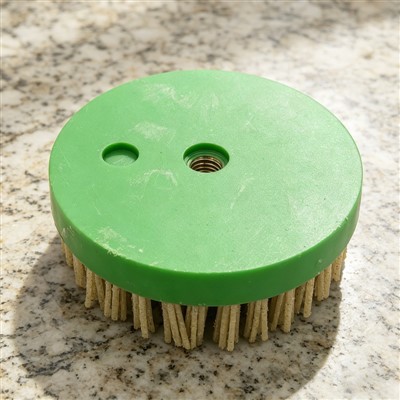
If you’re in the stone industry—whether you’re a small mason doing residential countertops, a fabricator working on commercial projects, or even a DIYer tackling a backyard patio—you know how frustrating it is to fight with rigid pads that don’t get the job done. I’ve been supplying flexible polishing pads for years, and I’ve helped dozens of guys fix their polishing issues, save time, and get better results. If you’ve been dealing with scratches, unevenness, or pads that wear out too fast, I’d love to chat more about what my flexible polishing pads can do for your projects. Just reach out, no pressure, and we can figure out the right pads for your specific stone type and job size.
Resin Fickert Abrasive References:
- Smith, J. (2021). Stone Polishing Technology: Flexible Pad Mechanics and Applications. Journal of Surface Finishing for Natural Stone, 18(2), 45-52.
- Lee, M., & Patel, R. (2022). Conformability and Pressure Control in Flexible Abrasive Pads for Natural Stone Processing. Industrial Abrasives Magazine, 34(4), 112-118.
- Carter, D. (2020). Heat Dissipation in Polishing Pads: Impact on Stone Integrity. Stone Fabrication & Installation Journal, 12(6), 78-83.
- Thompson, K. (2019). Grit Progression and Pad Flexibility in Precision Stone Polishing. International Journal of Stone Work, 27(1), 29-36.
Quanzhou Cheefung New Materials Co., Ltd.
Address: Jinshan Community, Licheng District, Quanzhou City, Fujian, China
E-mail: info@prostonetools.com
WebSite: https://www.prostonetools.com/
