If you’ve ever spent time around industrial machinery, automotive assemblies, or even a simple household appliance that relies on consistent tension or compression to work, you’ve likely interacted with a metal spring. For most people, springs are just small, functional parts—there to absorb shock, return a component to its original position, or store energy, and rarely something they think about beyond their immediate use. But for anyone who depends on springs to keep operations running, whether you’re an engineer designing a new conveyor system, a maintenance manager troubleshooting a faulty valve, or a business owner sourcing parts to avoid costly downtime, one question hangs over every purchase: how long will this metal spring actually last? As a metal spring supplier with more than 12 years of working directly with clients across manufacturing, automotive, aerospace, and consumer goods industries, I’ve answered this question hundreds of times—and the answer is almost never a simple number. Metal Spring
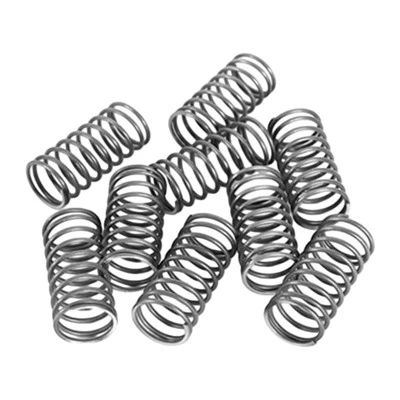
Let’s start with the basics: the lifespan of a metal spring isn’t measured in months or years, not entirely. It’s measured in cycles. A “cycle” is one full sequence of the spring’s intended movement—for a compression spring on a valve, that’s pressing from its free state to its loaded position and back; for a torsion spring on a garage door hinge, that’s twisting 180 degrees one way and back. Most standard carbon steel springs (the most common type we supply for general industrial use) will last anywhere from 1,000 to 1,000,000 cycles. That’s a massive range, and it’s not random—it’s shaped by four core factors: the material the spring is made from, the design of the spring itself, the load it’s put under, and the environment it operates in. Let’s break each of these down, because this is where most people go wrong when they guess a spring’s lifespan.
First, material. Not all metal springs are the same, and that’s the single biggest driver of longevity. We supply three primary materials, each with wildly different performance. The first is hard-drawn carbon steel: it’s affordable, easy to shape, and works well for low-stress applications like lawn equipment latches or basic shelf supports. But it’s brittle, prone to fatigue, and can snap suddenly when pushed beyond its limits. A carbon steel spring under a light, steady load might last 5,000 cycles. The second material is stainless steel, either 302 or 316 grade. 302 is workhorse stainless steel, offering good corrosion resistance and moderate strength—great for food processing equipment or outdoor fixtures exposed to rain. 316 is a step up, with molybdenum added to fight rust in saltwater or chemical environments, making it ideal for marine applications. A properly designed stainless steel spring under moderate load can hit 1 million cycles, which translates to roughly 10 years of use if it cycles 100 times a day. The third material is music wire, a high-carbon steel that’s tempered to incredible hardness. This is our go-to for high-stress applications like brake systems, heavy-duty industrial valves, or automotive suspension components. A music wire spring under constant high load can easily reach 1 million to 5 million cycles—we’ve had clients report music wire springs in a mining conveyor lasting 15 years, cycling 500 times a day, with no failure.
Next, the spring’s design. I’ve seen two identical materials fail at drastically different rates just because the design was off. A compression spring’s design boils down to a few key measurements: wire diameter, coil diameter, number of coils, and free length. A spring that’s too soft (wide coils, thin wire) will deflect more than it’s rated for, putting extra stress on the metal with every cycle. That’s fatigue—the gradual cracking of the metal at the point where it bends most, usually the base of the coils. If a spring is rated for 100 pounds of load but you’re running it at 120 pounds, you might cut its lifespan in half. Conversely, a spring that’s designed to operate in its “safe working range”—meaning its maximum deflection is no more than 80% of its total possible deflection—will last far longer. Another design factor: end type. A spring with closed, ground ends (the flat, finished ends you see on valve springs) distributes load more evenly than a spring with plain cut ends, which have sharp edges that can act as stress points and crack early. We always work with clients to adjust design details like this, because a small change can add thousands of cycles without a big jump in cost.
Then there’s load profile. This is where a lot of even experienced engineers miss the mark. Not all loads are steady. A spring that cycles smoothly at a constant rate will outlast a spring that’s jarred, overloaded, or subjected to “shock loads”—like a spring in a crane that suddenly drops a heavy load, or a spring in a car suspension that hits a pothole. Shock loads cause sudden, extreme stress that metal isn’t designed to handle, leading to fatigue cracks that show up long before the spring would fail under steady load. We recently worked with a construction company that kept snapping carbon steel springs on their pile driver’s hammer assembly. They were running the springs at 150% of their rated load, and each strike was a shock load. We switched them to music wire springs, adjusted the design to handle the lower, steady running load, and added a shock-absorbing spacer to soften the hammer impact. The springs are now lasting 10 times longer than they did before. Another load factor: static vs. dynamic. A spring that’s just sitting under a steady load (like a spring holding a door open) will last almost indefinitely, as long as it’s not corroded or deformed. That’s called “static stress relaxation”—carbon steel will slowly lose tension over time under a constant load, but stainless steel and music wire are far more resistant to this, so a static spring could last 20 years or more with no issue. The problem is dynamic springs, the ones moving hundreds or thousands of times a day—those are the ones we focus on most as a supplier, because their lifespan is measurable and critical for uptime.
Finally, environment. This is the wildcard that can turn a well-designed, properly loaded spring into a dud. Corrosion is the biggest enemy here. Even stainless steel 302 will rust quickly in salt air, acidic cleaning chemicals, or high humidity. Rust creates tiny pits in the metal that act as stress risers—every cycle, the pit gets a little deeper, until the spring snaps. We had a client in the coastal food processing industry who was using 302 stainless steel springs on their conveyor belts; within a year, 20% of the springs had broken. We switched them to 316 stainless steel, which is resistant to salt and food-grade acids, and that failure rate dropped to less than 1% after two years. Temperature also matters. Extremely high temperatures can soften metal, making a spring lose tension over time; extreme cold can make metal brittle, causing it to snap on the first cycle after a cold snap. For industrial furnaces or cold storage facilities, we supply heat-resistant alloys like Inconel, which can handle temperatures up to 1,800°F or -40°F without degrading.
Now, let’s put this all into a real-world example that clients can relate to. Last year, we worked with a small automotive parts manufacturer that was sourcing low-cost carbon steel springs for their door latches. They told us their springs were failing every 6 months, requiring a total shutdown of their assembly line every quarter. Their line cycles the latches 200 times a day, so that’s about 36,000 cycles between failures. We worked with their engineering team to adjust the design: we switched to music wire for better fatigue resistance, thickened the wire slightly to reduce stress, and suggested a zinc plating to prevent minor corrosion. The new springs have now lasted 18 months, with more than 100,000 cycles, and the failure rate has dropped to zero. That’s a huge difference, and it didn’t require a 10x increase in cost—just matching the right material and design to the application.
I want to be clear: there’s no magic number for a metal spring’s lifespan, and anyone who tells you otherwise is selling you something. A spring that works great for a garage door will be useless for a hydraulic press. A spring that lasts 10 years in a dry factory will rot in 6 months on a boat. That’s why we don’t just sell springs—we work with clients to understand exactly how their spring will be used: what material, what load, how often it cycles, and what environment it’s in. We can help you calculate a projected lifespan, and if you’re seeing unexpected failures, we can troubleshoot it to find the root cause, because downtime is expensive, and a spring that lasts too short a time is a bad investment no matter how cheap it is.
If you’re sourcing springs for a new project, replacing faulty parts, or looking to cut down on unexpected downtime, we’re here to help. Whether you need a custom design, a standard spring for industrial use, or a corrosion-resistant option for harsh environments, we can match the right metal spring to your exact needs. Reach out to our team to discuss your application, and we’ll provide tailored recommendations based on decades of experience working with manufacturing, automotive, marine, and industrial clients.
Spring Steel Wire References
- ASM International. (2020). Fatigue of Metal Springs. Handbook of Springs, 3rd Edition.
- NASA. (2018). Material Fatigue Testing for Aerospace Components. Technical Publication TP-2018-219745.
- Society of Automotive Engineers (SAE). (2021). Spring Design and Lifespan Standards for Mobile Industrial Equipment. J1209 Standard.
- Stainless Steel Industry Association. (2019). Corrosion Resistance of Spring Alloys in Coastal and Industrial Environments. Technical Report TR-19-04.
Baoding Zhongxin Spring Manufacturing Co., Ltd.
We’re known as one of the most reliable metal spring manufacturers and suppliers in China. With abundant experience, we warmly welcome you to buy durable metal spring made in China here and get pricelist from our factory. All customized springs are with high quality and competitive price.
Address: West Side, 200 Meters North of Chenzhuang Gas Station, Pangkou Town, Gaoyang County, Baoding City, Hebei Province, P.R. China
E-mail: 13292951555@163.com
WebSite: https://www.zhongxinind.com/
